| All returns accepted | ReturnsNotAccepted |
|---|---|
| Brand | TIMELESS FOUNDRY |
| Type | Graphite Coin Mold |
| Theme | Metal Casting |
| Material | Graphite |
| Country/Region of Manufacture | United States |
| Handmade | Yes |
| Suitable For | Graphite Mold |
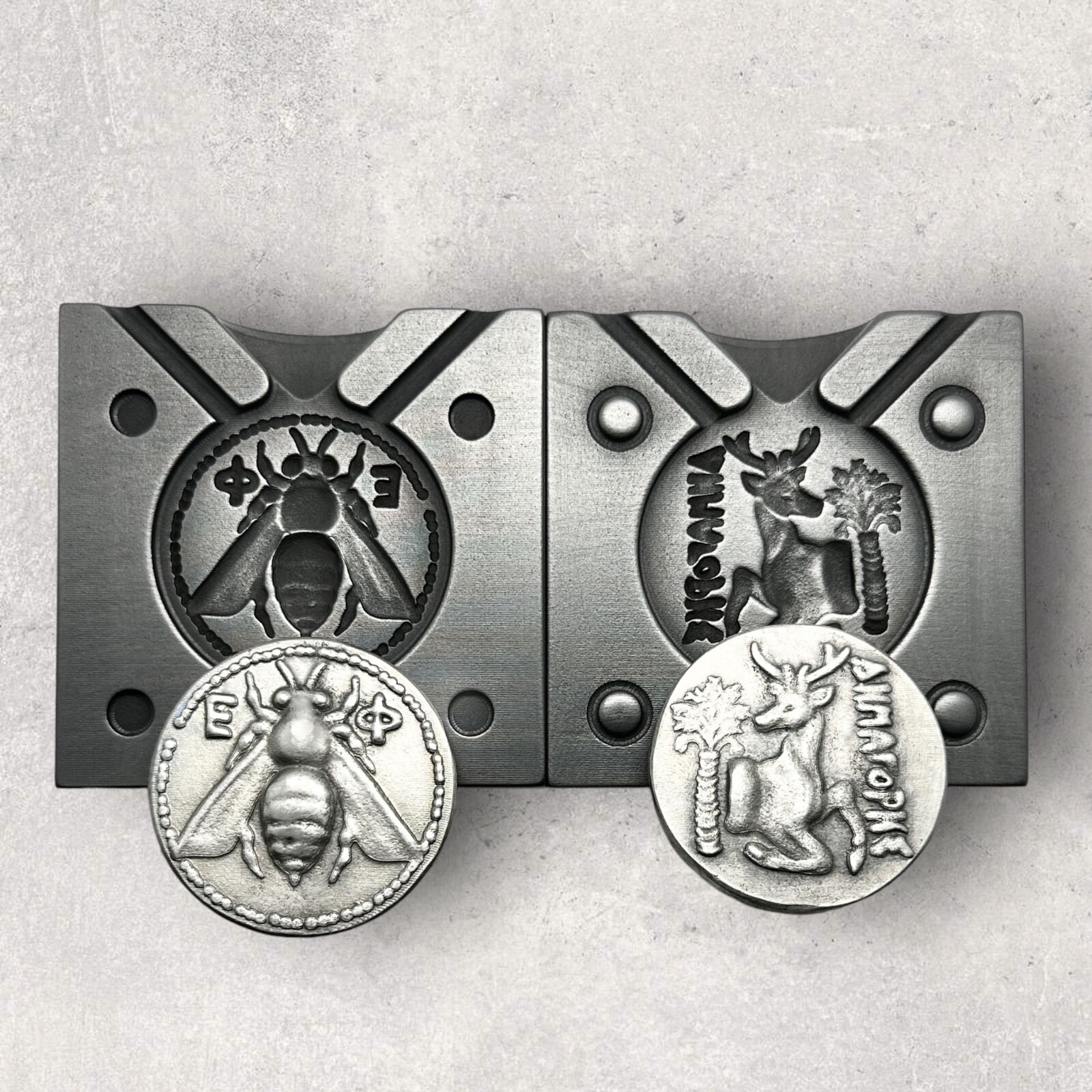
Check the listing for details. GREEK TETRADRACHM Of EPHESOS - (2 Sided) Graphite Coin Mold. Condition: New. Listed at 89.00 USD. This mold is modeled after the silver tetradrachm (four-drachma coin) and is stamped on the obverse with a bee within a dotted border, with the Greek letters, Ε (‘epsilon’) and Φ (‘phi’), to either side. The reverse shows the foreparts of a stag kneeling in right profile, looking back towards a palm tree. An inscription to the right reads ΚΑΡΝΩ[Ψ] (‘KARNO[PS]’). The bee, stag, and palm are all emblems of Ephesos, a Greek city on the west coast of Turkey. This city was an important center of worship for the Greek goddess Artemis, and the images on Ephesian coinage typically promote this association. The bee was originally the symbol of an early Anatolian goddess who the Greeks later identified with their goddess, Artemis; so close was the connection that the priestesses of the goddess were called "honey bees." The two Greek letters, Ε (‘epsilon’) and Φ (‘phi’), are an abbreviation for Ephesos. The palm tree alludes to Artemis' birth beneath a palm tree on the island of Delos. The stag – an animal sacred to Artemis – symbolizes the goddess' role as protector of wild animals, and may also refer to the sculptures that flanked her cult statue in the temple at Ephesos.------This high-density graphite mold is made of 99.9% pure graphite and produces coins that are approximately 40mm in diameter with a thickness of 3mm. ***METAL COINS IN IMAGES ARE FOR DEPICTION ONLY AND ARE NOT INCLUDED WITH PURCHASE***This mold is modeled after the silver tetradrachm (four-drachma coin) and is stamped on the obverse with a bee within a dotted border, with the Greek letters, Ε (‘epsilon’) and Φ (‘phi’), to either side. The reverse shows the foreparts of a stag kneeling in right profile, looking back towards a palm tree. An inscription to the right reads ΚΑΡΝΩ[Ψ] (‘KARNO[PS]’). The bee, stag, and palm are all emblems of Ephesos, a Greek city on the west coast of Turkey. This city was an important center of worship for the Greek goddess Artemis, and the images on Ephesian coinage typically promote this association. The bee was originally the symbol of an early Anatolian goddess who the Greeks later identified with their goddess, Artemis; so close was the connection that the priestesses of the goddess were called "honey bees." The two Greek letters, Ε (‘epsilon’) and Φ (‘phi’), are an abbreviation for Ephesos. The palm tree alludes to Artemis' birth beneath a palm tree on the island of Delos. The stag – an animal sacred to Artemis – symbolizes the goddess' role as protector of wild animals, and may also refer to the sculptures that flanked her cult statue in the temple at Ephesos.------This high-density graphite mold is made of 99.9% pure graphite and produces coins that are approximately 40mm in diameter with a thickness of 3mm. ***METAL COINS IN IMAGES ARE FOR DEPICTION ONLY AND ARE NOT INCLUDED WITH PURCHASE***
You may also like
![French Obole Of Antione "The Good" [1500's A.D.] - (2 Sided) Graphite Coin Mold](/image/SPQAAOSwYpNnlJGk/french-obole-of-antione-the-good-1500s-a-d-2-sided-graphite-coin-mold.jpg)