| All returns accepted | ReturnsNotAccepted |
|---|---|
| Availability | Retired / Sold Out |
| Character | Donald Duck |
| Edition Size | Limited Release |
| Size | 1.5 inches x 2.25 inches |
| Exclusive | Yes |
| Franchise | Disney |
| Modified Item | No |
| Brand | Disney |
| Type | Single |
| Year | 2019 |
| Exclusive to | Disneyland / Disney World Annual Passholders |
| Theme | Easter |
| Release Date | April 5, 2019 |
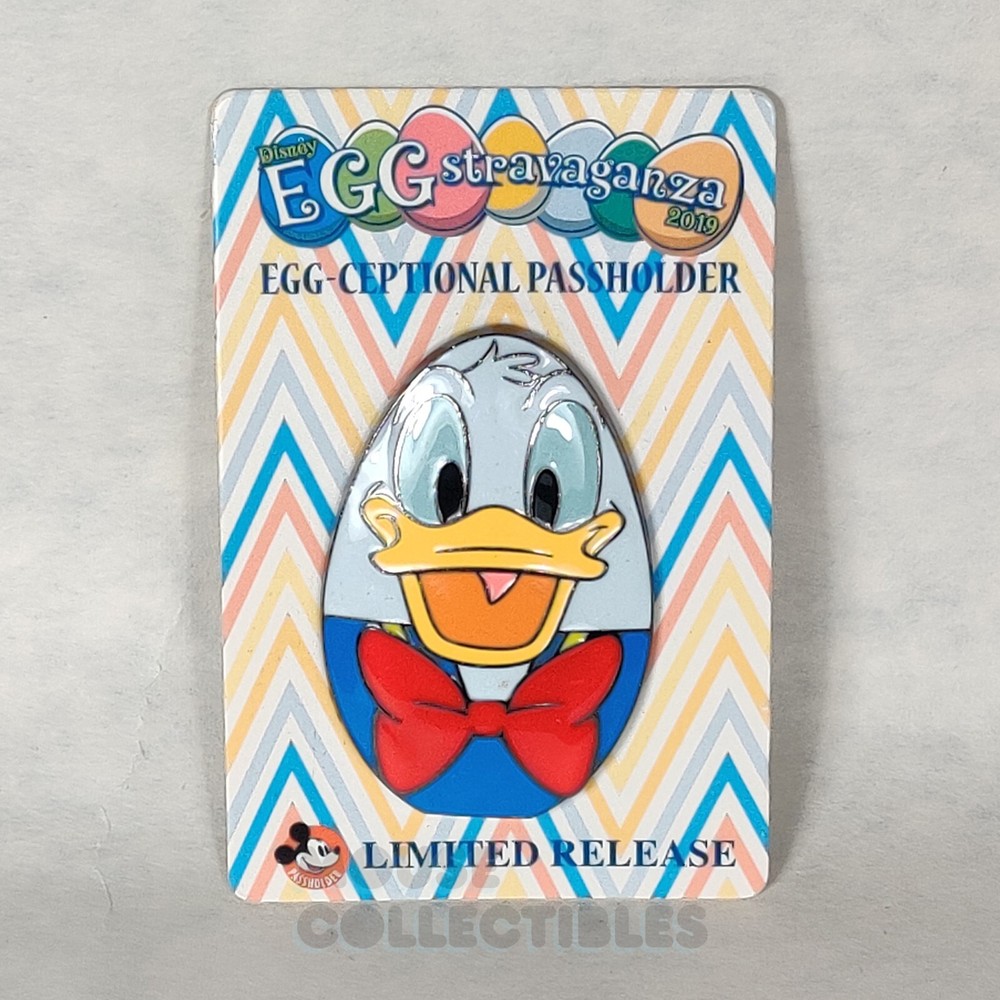
Check the listing for details. Disney Parks Easter Egg Pin Donald Duck EGGstravaganza Egg Hunt AP 2019. Condition: New. Listed at 29.99 USD. Disney Parks Character Egg PinCondition: NewCharacter(s): Donald DuckRelease Date: April 5, 2019Edition Size: Limited ReleaseAvailability: Retired/Sold OutThis special edition pin features Donald Duck as a shaped Easter egg. The egg-ceptional pin was released exclusively for Disneyland and Walt Disney World Annual Passholders during the 2019 EGGstravaganza Egg Hunt event on April 5, 2019. The egg shaped pin is blue and white with Donald Duck's face and sailor inspired outfit (including a large red bow tie). The large pin measures approximately 1.5 inches x 2.25 inches. The pin was exclusively available at the 2019 Disney Parks Eggstravaganza Egg Hunt. It is retired and no longer available. Please send a message with any questions. Thank you! SHIPPING: Purchases of $150+ will ship with signature confirmation. Need it faster? Expedited shipping is available in the shipping options. International shipping is available through eBay's Global Shipping program. All text and photos are copyright © 2023 Mouse Collectibles and More Donald Fauntleroy Duck is a cartoon character created by The Walt Disney Company. Donald is an anthropomorphic white duck with a yellow-orange bill, legs, and feet. He typically wears a sailor shirt and cap with a bow tie. Donald is known for his semi-intelligible speech and his mischievous, temperamental, and pompous personality. Along with his friend Mickey Mouse, Donald was included in TV Guide's list of the 50 greatest cartoon characters of all time in 2002, and has earned a star on the Hollywood Walk of Fame. He has appeared in more films than any other Disney character, and is the most published comic book character in the world outside of the superhero genre. Donald Duck appeared in comedic roles in animated cartoons. Donald's first theatrical appearance was in The Wise Little Hen (1934), but it was his second appearance in Orphan's Benefit that same year that introduced him as a temperamental comic foil to Mickey Mouse. Throughout the next two decades, Donald appeared in over 150 theatrical films, several of which were recognized at the Academy Awards. In the 1930s, he typically appeared as part of a comic trio with Mickey and Goofy and was given his own film series starting with Don Donald (1937). These films introduced Donald's love interest and permanent girlfriend Daisy Duck and often included his three nephews Huey, Dewey, and Louie. After the film Chips Ahoy (1956), Donald appeared primarily in educational films before eventually returning to theatrical animation in Mickey's Christmas Carol (1983). His last appearance in a theatrical film was in Fantasia 2000 (1999). However, since then Donald has appeared in direct-to-video features such as Mickey, Donald, Goofy: The Three Musketeers (2004), television series such as Mickey Mouse Clubhouse (2006–2016), and video games such as QuackShot (1991). In addition to animation, Donald is well-known worldwide for his appearances in comics. Donald was most famously drawn by Al Taliaferro, Carl Barks, and Don Rosa. Barks, in particular, is credited for greatly expanding the "Donald Duck universe", the world in which Donald lives, and creating many additional characters such as Donald's rich uncle Scrooge McDuck. Donald has been a popular character in Europe, particularly in Nordic countries where his weekly magazine Donald Duck & Co was the comics publication with the highest circulation from the 1950s to 2009. In Italy, Donald is a major character in many comics, including a juvenile version named Paperino Paperotto, and a superhero alter ego known as Paperinik (Duck Avenger in the US and Superduck in the UK). The character is known for possessing an only partly intelligible voice, developed by Donald's original performer, Clarence Nash. The voice actor produces sounds by forcing air through the mouth using the muscles of the cheek, rather than from the lungs as in typical speech. Nash reputedly originally developed the voice as that of a "nervous baby goat" before Walt Disney interpreted it as sounding like a duck. PersonalityDonald's two dominant personality traits are his fiery temper and his upbeat attitude to life. Many Donald shorts start with Donald in a happy mood, without a care in the world until something comes along and spoils his day. His rage is a great cause of suffering in his life. On multiple occasions, it has caused him to get in over his head and lose competitions. There are times when he fights to keep his temper in check, and he sometimes succeeds in doing so temporarily, but he always returns to his normal angry self in the end. Donald's aggressive nature has its advantages, however. While at times it is a hindrance, and even a handicap, it has also helped him in times of need. When faced with a threat of some kind, for example, Pete's attempts to intimidate him, he is initially scared, but his fear is replaced by anger. As a result, instead of running away, he fights. In fact, his anger can make him powerful enough to defeat ghosts, much stronger individuals, sharks, mountain goats, giant kites, and even the forces of nature. Donald is something of a prankster, and as a result, he can sometimes come across as a bit of a bully, especially in the way he sometimes treats Chip n' Dale and Huey, Dewey and Louie, his nephews. As the animator Fred Spencer has put it: The Duck gets a big kick out of imposing on other people or annoying them, but he immediately loses his temper when the tables are turned. In other words, he can dish it out, but he can't take it. However, with a few exceptions, there is seldom any harm in Donald's pranks. He almost never intends to hurt anyone, and when his pranks go too far, he is often apologetic. In Truant Officer Donald, for example, when he is tricked into believing he has accidentally killed Huey, Dewey, and Louie, he shows great regret, blaming himself. His nephews appear in the form of angels, and he willingly endures a kick by one of them—that is, of course, until he realizes he has been tricked, whereupon he promptly loses his temper. Donald is also a bit of a poseur. He likes to brag, especially about how skilled he is at something. He does, in fact, have many skills—he is something of a Jack-of-all-trades. Amongst other things, he is a talented fisher and a competent hockey player. However, his love of bragging often leads him to overestimate his abilities, so that when he sets out to make good on his boasts, he gets in over his head, usually to hilarious effect. Another of his personality traits is perseverance. Even though he can at times be a slacker, and likes to say that his favorite place to be is in a hammock, once he has committed to accomplishing something he goes for it 100 percent, sometimes resorting to extreme measures to reach his goal. PhrasesDonald has a few memorable phrases that he occasionally comes out with in certain situations. For example, when he stumbles across other characters in the midst of planning some sort of retaliation or prank, or when things do not go as he had planned or do not work properly, he often says, "What's the big idea!?" When he gives up on something he is trying to do, or something he hopes will happen, he tends to say, "Aw, phooey!" When he confronts someone/something that is antagonizing or frustrating him, he tends to exclaim, "So!!" He greets his girlfriend Daisy, and occasionally others, with, "Hiya, toots!" And when he is very excited about something, he usually mutters, "Oh boy, oh boy, oh boy..." under his breath. HealthThere is a running gag in the Donald Duck comics about him being physically unhealthy and unmotivated to exercise. Usually, some character close to Donald annoys him by saying he is being lazy and needs to get some exercise. But despite his apparent idleness, Donald proves that he is muscular. In the short film, Sea Scouts, Donald is traveling with his nephews in a boat when it is attacked by a shark. Donald makes several attempts to defeat the shark, each of which proves ineffective, but then finally triumphs and defeats the shark with a single well-placed punch. Additionally, as discussed below- Donald had a stint in the U.S. Army during World War II that culminated with him serving as a commando in the film Commando Duck, and he was frequently away serving in the U.S. Navy in the television cartoon series DuckTales. Friendly rivalry with Mickey MouseThroughout his appearances, Donald has shown that he is jealous of Mickey and wants his job as Disney's greatest star, similar to the rivalry between Bugs Bunny and Daffy Duck. In most Disney theatrical cartoons, Mickey and Donald are shown as friends and have little to no rivalry (exceptions being The Band Concert, Magician Mickey and near the end of Symphony Hour, which were due to Donald's antagonistic schemes). However, by the time The Mickey Mouse Club aired on television (after Bugs vs. Daffy cartoons such as the "hunting trilogy" of Rabbit Fire, Rabbit Seasoning, and Duck! Rabbit, Duck!), it was shown that Donald always wanted the spotlight. One animated short that rivaled the Mickey Mouse March song showed Huey, Dewey, and Louie as Boy Scouts and Donald as their Scoutmaster at a cliff near a remote forest and Donald leads them in a song mirroring the Mouseketeers theme "D-O-N-A-L-D D-U-C-K! Donald Duck!" The rivalry has caused Donald some problems, for example in a 1988 TV special, where Mickey is cursed by a sorcerer to become unnoticed, the world believes Mickey to be kidnapped. Donald Duck is then arrested for the kidnapping of Mickey, as he is considered to be the chief suspect, due to their feud. However, Donald did later get the charges dismissed, due to lack of evidence. Walt Disney, in his Wonderful World of Color, would sometimes make reference to the rivalry. Walt, one time, had presented Donald with a gigantic birthday cake and commented how it was "even bigger than Mickey's", which pleased Donald. The clip was rebroadcast in November 1984 during a TV special honoring Donald's 50th birthday, with Dick Van Dyke substituting for Walt. EnemiesDonald has numerous enemies, who range from comical foil to annoying nemesis: Chip 'n' Dale, Pete, Humphrey the Bear, Spike the Bee, Mountain Lion Louie, Bootle Beetle, Witch Hazel (in Trick or Treat), Aracuan Bird and Baby Shelby (in Mickey Mouse Works). OriginVoice performer Clarence Nash auditioned for Walt Disney Studios when he learned that Disney was looking for people to create animal sounds for his cartoons. Disney was particularly impressed with Nash's duck imitation and chose him to voice the new character. Disney came up with Donald's iconic attributes including his short temper and his sailor suit (based on ducks and sailors both being associated with water). While Dick Huemer and Art Babbit were the first to animate Donald, Dick Lundy is credited for developing him as a character. On April 29, 1934, five days before The Wise Little Hen's first theatrical release, bandleader Raymond Paige performed the score to the cartoon on his California Melodies program for the Los Angeles AM radio station KHJ. The main vocals were performed by a trio, the Three Rhythm Kings. Clarence Nash and Florence Gill performed the character voices for this radio treatment, with Nash performing both Donald Duck and Peter Pig, making it the first time the public heard Nash's duck voice. AnimationDonald Duck's first film appearance was in the 1934 cartoon The Wise Little Hen, which was part of the Silly Symphonies series of theatrical cartoon shorts. The film's given release date of June 9 is officially recognized by the Walt Disney Company as Donald's birthday, though historian J.B. Kaufman, consultant of The Walt Disney Family Museum, discovered in recent years that The Wise Little Hen was first shown on May 3, 1934 at the Carthay Circle Theater for a benefit program, while its official debut was on June 7 at the Radio City Music Hall. Donald's appearance in the cartoon, as created by animator Dick Lundy, is similar to his modern look – the feather and beak colors are the same, as are the blue sailor shirt and hat – but his features are more elongated, his body plumper, his feet smaller, and his sclerae white. Donald's personality is not developed either; in the short, he only fills the role of the unhelpful friend from the original story. Burt Gillett brought Donald back in a 1934 Mickey Mouse cartoon, Orphans' Benefit. Donald is one of a number of characters who are giving performances in a benefit for Mickey's Orphans. Donald's act is to recite the poems Mary Had a Little Lamb and Little Boy Blue, but every time he tries, the mischievous orphans heckle him, leading the duck to fly into a squawking fit of anger. This explosive personality would remain with Donald for decades to come. Donald continued to be a hit with audiences. The character began appearing regularly in most Mickey Mouse cartoons. Cartoons from this period, such as the cartoon The Band Concert (1935) – in which Donald repeatedly disrupts the Mickey Mouse Orchestra's rendition of The William Tell Overture by playing Turkey in the Straw – are regularly noted by critics as exemplary films and classics of animation. Animator Ben Sharpsteen also created the classic Mickey, Donald, and Goofy comedy in 1935, with the cartoon Mickey's Service Station. In 1936, Donald was redesigned to be a bit fuller, rounder, and cuter, beginning with the cartoon Moving Day. He also began starring in solo cartoons, the first of which was Ben Sharpsteen's 1937 cartoon, Don Donald. This short also introduced a love interest of Donald's, Donna Duck, who evolved into Daisy Duck. Donald's nephews, Huey, Dewey and Louie, would make their first animated appearance a year later in the 1938 film, Donald's Nephews, directed by Jack King (they had been earlier introduced in the Donald Duck comic strip by Al Taliaferro, see below). By 1938, most polls showed that Donald was more popular than Mickey Mouse. Post-warMany of Donald's films made after the war recast the duck as the brunt of some other character's pestering. Donald is seen repeatedly attacked, harassed, and ridiculed by his nephews, by the chipmunks Chip 'n' Dale, or by other characters such as Humphrey the Bear, Spike the Bee, Bootle Beetle, the Aracuan Bird, Louie the Mountain Lion, or a colony of ants. In effect, much like Bugs Bunny cartoons from Warner Bros. the Disney artists had reversed the classic screwball scenario perfected by Walter Lantz and others in which the main character is the instigator of these harassing behaviors, rather than the butt of them. The post-war Donald also starred in educational films, such as Donald in Mathmagic Land and How to Have an Accident at Work (both 1959), and made cameos in various Disney projects, such as The Reluctant Dragon (1941) and the Disneyland television show (1959). For this latter show, Donald's uncles Ludwig von Drake (1961) and Scrooge McDuck (1967) were then created in animation. In Who Framed Roger Rabbit (1988), Donald has a piano duel scene with his Warner Brothers counterpart Daffy Duck voiced by Mel Blanc. Donald has since appeared in several different television shows and (short) animated movies. He played roles in The Prince and the Pauper (1990) and made a cameo appearance in A Goofy Movie (1995). Donald had a rather small part in the animated television series DuckTales. There, Donald joins the U.S. Navy and leaves his nephews Huey, Dewey, and Louie with their Uncle Scrooge, who then has to take care of them. Donald's role in the overall series was fairly limited, as he only ended up appearing in a handful of episodes when home on leave. Some of the stories in the series were loosely based on the comics by Carl Barks. Donald made some cameo appearances in Bonkers, before getting his own television show Quack Pack. This series featured a modernized Duck family. Donald was no longer wearing his sailor suit and hat, but a Hawaiian shirt. Huey, Dewey, and Louie now are teenagers, with distinct clothing, voices, and personalities. Daisy Duck has lost her pink dress and bow and has a new haircut. No other family members, besides Ludwig von Drake, appear in Quack Pack, and all other Duckburg citizens are humans and not dogs. He made a comeback as the star of the "Noah's Ark" segment of Fantasia 2000 (1999), as first mate to Noah. Donald musters the animals to the Ark and attempts to control them. He tragically believes that Daisy has been lost, while she believes the same of him, but they are reunited at the end. All this to Edward Elgar's Pomp and Circumstance Marches 1–4. In an alternate opening for the Disney film Chicken Little (2005), Donald would have made a cameo appearance as "Ducky Lucky". This scene can be found on the Chicken Little DVD. Voice actorsDonald's first voice was performed by Clarence Nash, who voiced him for 50 years. Nash voiced Donald for the last time in Mickey's Christmas Carol (1983), making Donald the only character in the film to be voiced by his original voice actor. He did, however, continue to provide Donald's voice for commercials, promos, and other miscellaneous material until he died in 1985. Since Nash died, Donald's voice has been performed by Disney animator, Tony Anselmo, who was mentored by Nash for the role. Anselmo's first performance as Donald is heard in a 1986 D-TV special, D-TV Valentine on The Disney Channel, and in his first feature film, Who Framed Roger Rabbit, in 1988. Walt Disney insisted on character consistency, and integrity. However there were instances in which other actors would voice Disney characters for various smaller films, recordings, theme parks and other projects. Accuracy and consistency became an issue. in 1988, Imagineer Les Perkins convinced Jeffrey Katzenberg and Roy E. Disney to approved the creation the department of Disney Character Voices to insure continuation of character integrity, consistency, and quality in recording methods. Roy named one official voice for all Walt Disney legacy characters. Tony Anselmo was approved by Roy E. Disney as Disney's official voice of Donald Duck. For the TV series Mickey and the Roadster Racers, later named Mickey Mouse Mixed-Up Adventures, Donald was voiced by voice actor Daniel Ross, while Anselmo continues as the official voice of Donald on all other Disney projects, DuckTales, Mickey Mouse shorts, Legend of the Three Caballeros, Kingdom Hearts III, Disney Parks, attractions, and consumer products. Disney theme parksDonald Duck has played a major role in many Disney theme parks over the years. He has actually been seen in more attractions and shows at the parks than Mickey Mouse has. He has appeared over the years in such attractions as Animagique, Mickey Mouse Revue, Mickey's PhilharMagic, Disneyland: The First 50 Magical Years, Gran Fiesta Tour Starring the Three Caballeros and the updated version of "It's a Small World". He also is seen in the parks as a meet-and-greet character. Children's booksDonald has been a frequent character in children's books beginning in 1935. Most of these books were published by Whitman Publishing, later called Western Publishing, or one of its subsidiaries. The following is a list of children's books in which Donald is the central character. This does not include comic books or activity books such as coloring books. Donald is the only significant film and television cartoon character to appear as a mascot for a major American university: a licensing agreement between Disney and the University of Oregon allows the school's sports teams to use Donald's image as its "Fighting Duck" mascot. In 1984, Donald Duck was named an honorary alumnus of the University of Oregon during his 50th birthday celebration. During a visit to the Eugene Airport, 3,000 to 4,000 fans gathered for the presentation of an academic cap and gown to Donald. Thousands of area residents signed a congratulatory scroll for Donald, and that document is now part of Disney's corporate archives. In the 1940s, Donald was adopted as the mascot of Brazilian sports club Botafogo after Argentinean cartoonist Lorenzo Mollas, who was working in Brazil at the time, drew him with the club's soccer uniform. Mollas chose Donald because he complains and fights for his rights, like the club's managers at those years, and also because, being a duck, he does not lose his elegance while moving in the water (an allusion to rowing). He was eventually replaced so that the club would not have to pay royalties to Disney (Botafogo's current official mascot is Manequinho, a boy who represents the Manneken Pis statue in front of the club's head office), but has since retained the status of unofficial mascot. Donald's name and image are used on numerous commercial products, one example being Donald Duck brand orange juice, introduced by Citrus World in 1940. In 2005, Donald received his own star on the Hollywood Walk of Fame at 6840 Hollywood Blvd joining other fictional characters such as Mickey Mouse, Bugs Bunny, Woody Woodpecker, The Simpsons, Winnie the Pooh, Kermit the Frog, Big Bird, Godzilla and Snow White. Donald's fame has led Disney to license the character for a number of video games, such as the Kingdom Hearts series, where Donald is the court magician of Disney Castle. He accompanies Goofy and a young boy named Sora on a quest to find King Mickey Mouse, defeat the Heartless and Nobodies, and put an end to the evil Xehanort and Organization XIII. He is voiced by Tony Anselmo in the English version and Kōichi Yamadera in the Japanese version. (Wikipedia)
You may also like