| Restocking Fee | No |
|---|---|
| Return shipping will be paid by | Buyer |
| All returns accepted | Returns Accepted |
| Item must be returned within | 30 Days |
| Refund will be given as | Money Back |
| UPC | Does Not Apply |
| MPN | Does Not Apply |
| Brand | Feedback |
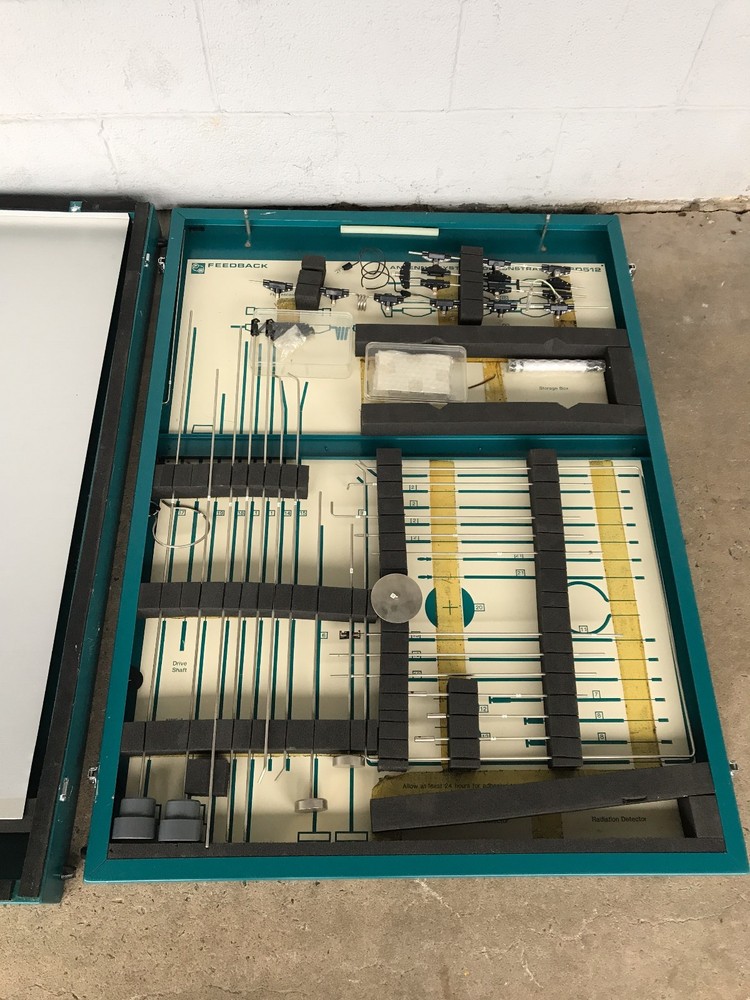
Check the listing for details. Feedback Antenna Systems Demonstrator ASD512 Trainer. Condition: For parts or not working. Listed at 899.99 USD. Feedback Antenna Systems Demonstrator ASD512 Trainer RF Generator ASD512 powers up. No further testing was performed. One cable to go from voltage and current detector and radiation detector is included. Antennas and equipment shown in pictures is included. One foot on case is missing see pictures. This is a freight item. Please email for quote. Operational antennas are built in a great range of shapes and sizes, depending on the function and operating frequency. At low frequencies the equipment could be too large to be manageable and at high frequencies too small to analyse. These factors are an essential consideration in the design of an antenna systems demonstrator. The ASD512 is a fully operational Antenna Systems Demonstrator working at a frequency of 167.2MHz, giving a half-wave element of approx. 90cm - an ideal size for classroom demonstration. Many types of antenna can be constructed from a few component parts making the ASD512 an extremely versatile demonstrator of antenna principles and practice. Considerable use is made of illuminated hand-held detector displays, which show the relative magnitude of voltage and current fields around the antenna and the field strength of the radiated signal at a distance from the antenna. Practical demonstrations described in the associated manuals illustrate the principles involved, thus introducing students of various levels to the basic concepts, leading on to an understanding of most types of antennas in common use. Features • Fully operational antennas • Vivid displays of antenna characteristics • Convenient size for classroom • Versatile and easy to assemble • Complex concepts made easy • Reconciles theory and practice Radio Communications The world would be a very different place without radio communications. There would be no broadcasting, no television and all long distance telephone calls would have to go by cable. Man’s leap into space would have been impossible and the world’s airways would be very few and very dangerous without reliable radio. The apparatus of a radio link starts with a transmitter and ends with a receiver, but neither is complete without an antenna. A transmitter does not generate high-frequency electrical oscillations; these must be fed into an antenna to generate a radio wave. Similarly, a radio receiver requires an antenna to convert an arriving radio wave into an electrical oscillation. The reliability of the communication link (or ‘circuit’ as it is sometimes called) often depends more on the antennas used than on transmitter power or receiver sensitivity. Antennas are available in many shapes and sizes and considerations such as space and cost can affect specification as much as technical characteristics. It is fortunate that antenna systems can be specified, installed, tested and maintained without a detailed knowledge of their theoretical design, since the theory is complicated and highly mathematical. The ASD512 offers a practical, non-mathematical understanding of how antennas work, allowing a range of simple design, installation, adjustment and maintenance exercises to be carried out to ensure that performance characteristics are met in practice. Equipment The Antenna Systems Demonstrator ASD512 is a self-contained set of equipment that promotes student participation. It is ideal for classroom demonstrations and does not require any special screening facilities. This demonstrator includes all the items to build and clearly demonstrates the majority of antennas described in the associated manuals. The half-wave element size of 90cm makes the ASD512 very easy to use and the low output power of the RF Generator ensures safety. The unique method of indicating V/I and the field strength with the hand-held detectors also helps the student to appreciate and understand complex concepts easily. Inv:I17-1373Loc:FL / TT3
You may also like