| Returns Accepted | ReturnsNotAccepted |
|---|---|
| Subject Area | Language Study |
| Item Height | 240 mm |
| Item Width | 180 mm |
| Author | William Rowlinson |
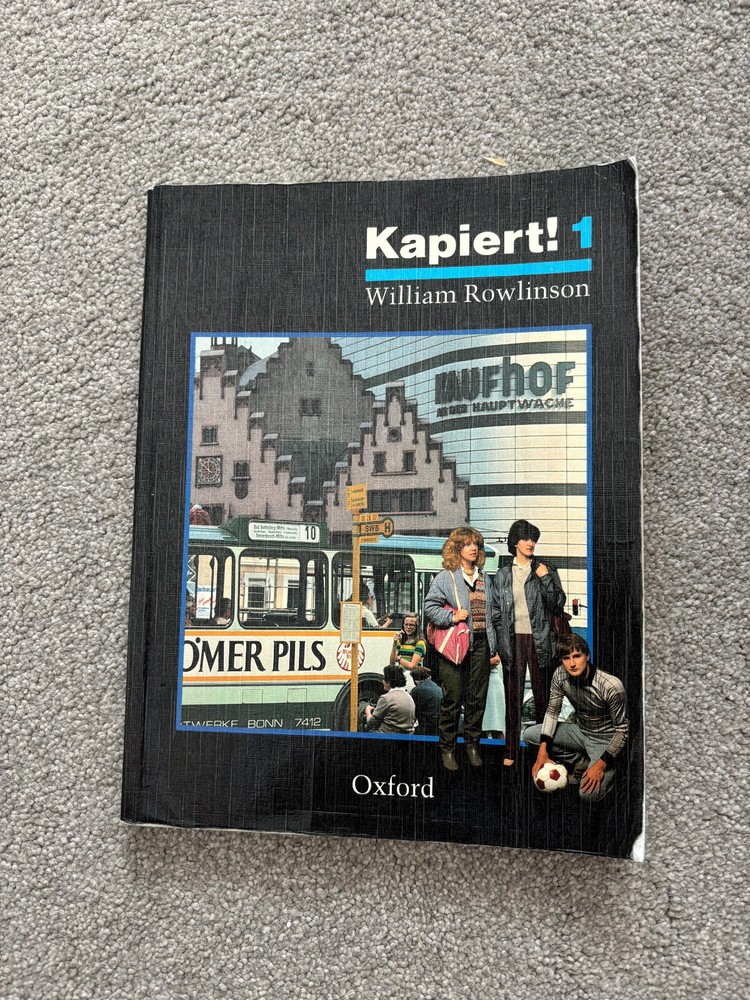
| Publication Name | Kapiert!: Pt. 1 |
| Format | Paperback |
| Language | English |
| Publisher | Oxford University Press |
| Publication Year | 1983 |
| Type | Study Guide |
| Item Weight | 427 g |
| Number of Pages | 192 Pages |
Check the listing for details. Kapiert!: Pt. 1 by William Rowlinson (Paperback, 1983). Condition: Acceptable. Listed at 7.63 USD. Kapiert! is a two-part German course with textbooks and tapes/cassettes leading to examinations at 16+. In format and approach it parallels the author's French course tout compris. The large number of short units allows the two parts of the course to be used over two, three or even four years and still give the pupils a real sense of progress; the generally adult approach also makes the course suitable for older school beginners and adults.The course is based on a grammatical syllabus with language in situation and language as function /e.g. expressing surprise, regret, liking; offering; thanking...) also determining content. Especially in the early stages a carefully graded one-step-at-a-time approach has been used, with new structures introduced with known vocabulary and vice versa: at this stage exercises within a unit are also sequentially graded. Though the grammar syllabus is a generally accepted one, teachers will note that some areas (the genitive, for instance) get much less stress than has often been the case. Frequently in the past the early years of German have been made unnecessarily complicated by attention to the exception and the rare at the expense of practice-time with the everyday and useful.All four skills- aural comprehension, speaking, reading, writing- are taught by the course. Though it is up to the individual teacher to decide what stress he or she puts on each of these, it is assumed that the first two will form the basis of most learning in the initial stages.Many exercises and activities are marked for pairwork.There is a growing realisation of the value of this technique in language classrooms to give pupils practice in oral interchange. It is, indeed, difficult to practise this skill effectively in normal-sized language classes without pairwork: nor can the language laboratory provide the face-to-face exchange of language that pairwork can.Before handing over an exercise to pairs, though, it is vital in these early stages that it be first worked through thoroughly with the whole class to make sure that pairs know what they are doing and how to do it accurately.
You may also like